How Spotify Wrapped 2025 Works: The Engineering Behind Your Year in Music
Every year, Spotify Wrapped gives you a personalized look back at your listening habits. But behind the scenes, a sophisticated blend of data science, machine learning, and audio engineering brings those highlights to life. Here's how the 2025 Wrapped was built — from the raw data to the story you see.
1. What data does Spotify collect to create your Wrapped highlights?
Spotify collects a rich set of listening events: every stream, skip, like, share, and playlist addition. For Wrapped 2025, additional signals like listening duration, time of day, and device type are aggregated. User behavior is anonymized and processed in batches. The data pipeline filters out noise (e.g., very short skips) and normalizes for volume differences. All personal data is handled with care, following strict privacy policies (more on that in question 6). Machine learning models then transform these raw logs into meaningful metrics: top artists, songs, genres, and even listening moods.
2. How does machine learning identify your top songs and artists?
Spotify uses a two-stage ML pipeline. First, a ranking model scores each artist and track based on recency, frequency, and time spent listening. Second, a diversity filter ensures your top 5 reflects genuine preference, not just short-term loops. Collaborative filtering (your behavior vs. similar users) further refines rankings. For 2025, the models also weigh listening freshness — how early you adopted new releases — giving credit for discovering hits before they became popular. The final output is a personalized top list that balances accuracy and surprise.
3. How does Spotify generate unique “listening moments” and stories?
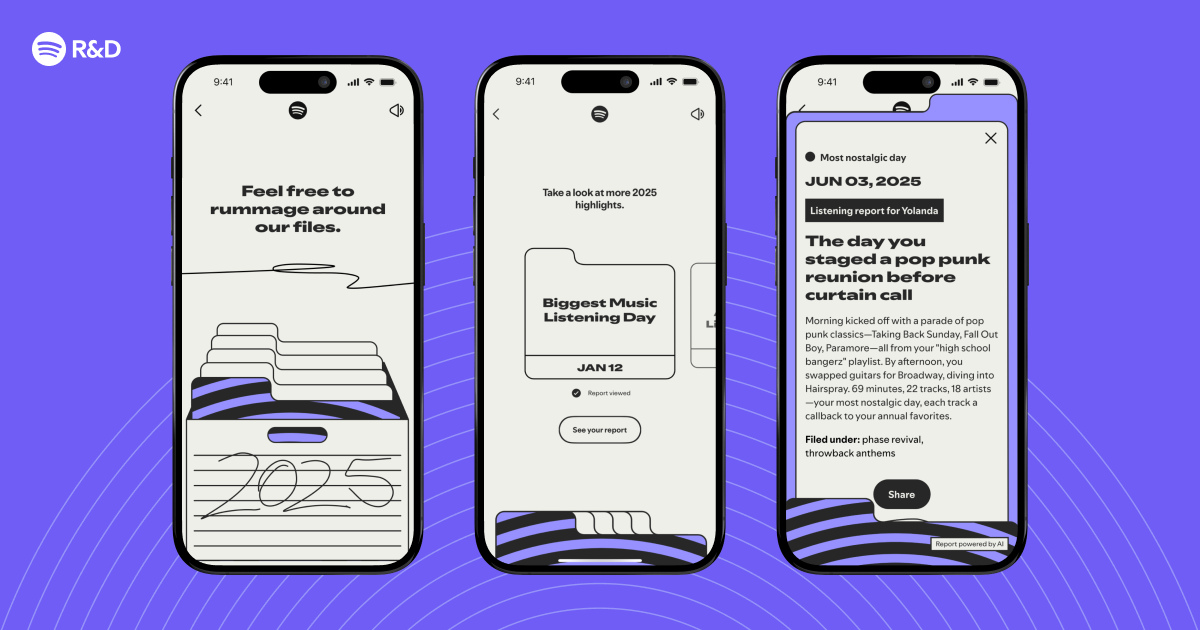
Instead of a static report, Wrapped 2025 weaves a narrative. This is done via a storytelling engine that detects patterns: “Your year started with upbeat pop, then shifted to lo-fi in April.” The engine uses audio features (tempo, energy, valence) to create emotional arcs. It also spots outlier events — a 50-stream day — and flags them as moments. Natural language generation (NLG) models then write short, human-like captions. Each story is unique to you, powered by sequence models that learn from millions of user histories.
4. How does the audio analysis engine determine song characteristics?
For every track in Spotify’s catalog, an audio analysis pipeline extracts low-level features: tempo, key, mode, loudness, and spectral shape. Advanced models like convolutional neural networks then derive high-level attributes: danceability, energy, acousticness, and valence (positivity). These features are pre-computed and stored. During Wrapped generation, your listening vector (average of all consumed tracks) is compared against these per-track profiles. This enables statements like “Your top songs were 20% more energetic than last year.”

5. What role does user clustering play in personalizing your Wrapped?
Wrapped is not just about you — it’s about where you fit. Spotify groups users with similar listening patterns into behavioral clusters (e.g., “late-night jazz enthusiasts” or “workout pop heads”). For 2025, clustering uses unsupervised learning on features like genre diversity, session length, and day part preferences. Once you’re assigned to a cluster, the system highlights how your year compares: “You listened to 40% more classical music than similar listeners.” This comparative layer adds context and makes the experience feel more social, even without direct sharing.
6. How does Spotify ensure data privacy and accuracy in Wrapped?
All data used for Wrapped is pseudonymized before processing; individual identities are stripped from analytic datasets. Aggregation happens in secure enclaves, with differential privacy applied: random noise is injected to prevent re-identification. Accuracy is validated through A/B testing — a control group sees a slightly different model, and feedback is compared. For 2025, a new time-window validation step checks that all listening events fall within the correct calendar year, removing any anomalies. Spotify also provides an option to view your deleted or hidden streams, giving full transparency.