How to Reimagine Man Pages for Better Clarity and Quick Reference
Introduction
Man pages are the quintessential documentation for command‑line tools, but many users find them dense and hard to navigate. After studying examples from well‑crafted man pages—like rsync, strace, and the Perl suite—I’ve identified three powerful techniques that can transform a typical man page into a quick‑reference powerhouse. This guide walks you through each technique step by step, helping you produce man pages that are both comprehensive and immediately usable.
What You Need
- A man page source file (typically written in troff/groff or mandoc format)
- A text editor capable of editing markup languages
- A deep understanding of your tool’s options, categories, and common use cases
- A willingness to experiment with structure and layout
- (Optional) The
mancommand to preview your changes locally
Step‑by‑Step Guide
Step 1: Assess Your Current Man Page
Before making any changes, open your existing man page and evaluate its strengths and weaknesses. Look for:
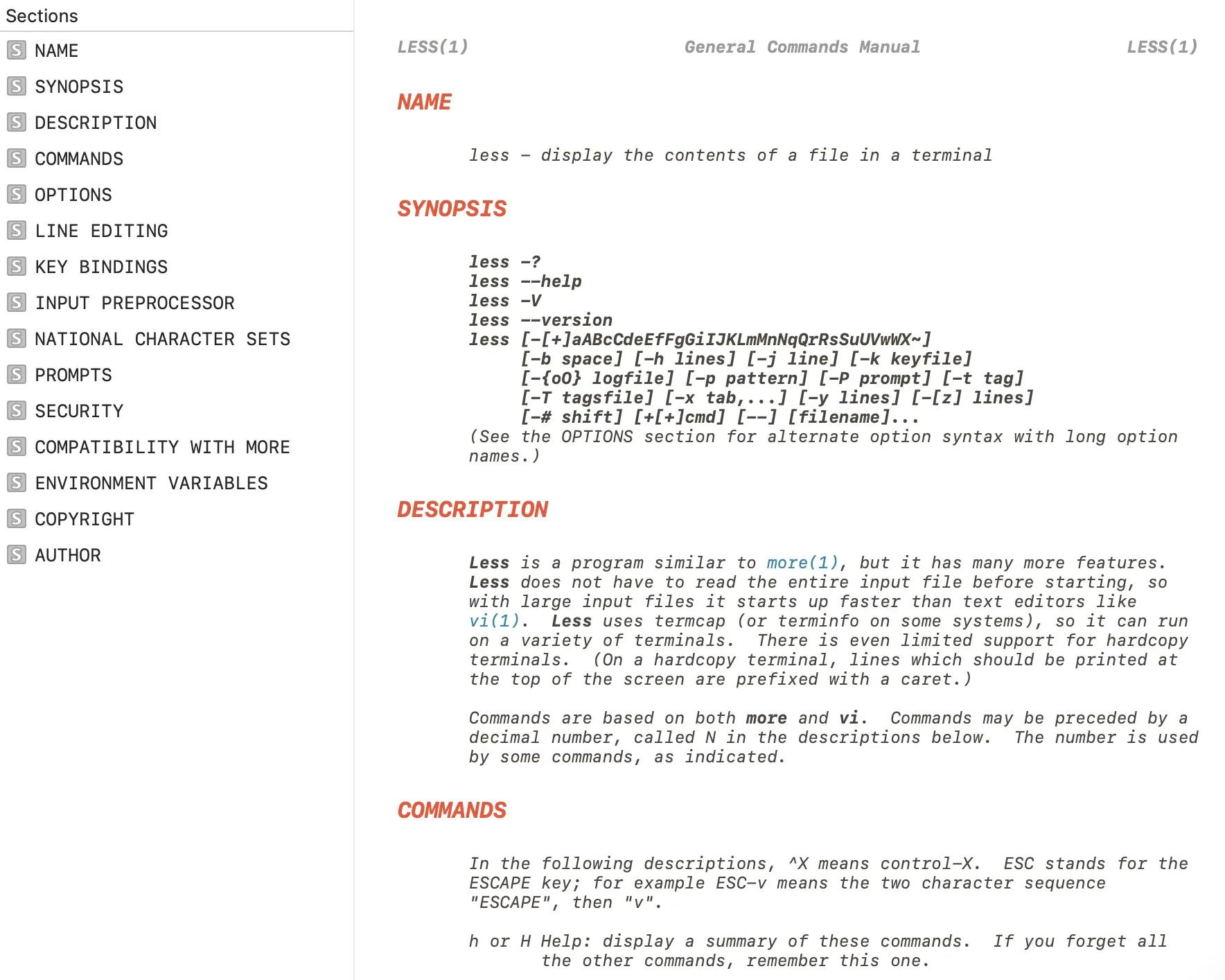
- A SYNOPSIS section that lists flags in a long, unbroken string (e.g.,
ls [-@ABCFGHILOPRSTUWabcdefghiklmnopqrstuvwxy1%,]). Such strings are hard to read and rarely helpful. - An OPTIONS section that simply lists options alphabetically without any grouping.
- No quick‑reference summary or cheat‑sheet content.
Identifying these pain points will guide the restructuring.
Step 2: Condense the SYNOPSIS to Its Core
The synopsis should give a high‑level view of command usage, not a laundry list of flags. Follow the example of rsync and keep it terse:
Local:
    rsync [OPTION...] SRC... [DEST]

Access via remote shell:
    Pull: rsync [OPTION...] [USER@]HOST:SRC... [DEST]
    Push: rsync [OPTION...] SRC... [USER@]HOST:DEST
This shows the command’s core syntax without drowning in options. The user knows what goes where.
Step 3: Add an OPTIONS SUMMARY Section
Right after the SYNOPSIS, insert an OPTIONS SUMMARY block. This is a compact, one‑line‑per‑option list that acts as a cheat sheet. Each line contains the long and short flags, followed by a brief description.
--verbose, -v          increase verbosity
--info=FLAGS           fine‑grained informational verbosity
--debug=FLAGS          fine‑grained debug verbosity
--stderr=e|a|c         change stderr output mode (default: errors)
--quiet, -q            suppress non‑error messages
--no-motd              suppress daemon‑mode MOTD
Keep each description to a few words. This summary lets users quickly scan for the flag they need without reading paragraphs.
Step 4: Organize the Full OPTIONS Section by Category
Instead of alphabetizing every option, group them logically. The strace man page uses categories like “General”, “Startup”, “Tracing”, “Filtering”, and “Output Format”. This helps users who know what kind of option they need but can’t recall the flag’s name.
To implement this:
- List every option and assign it to a category.
- Within each category, optionally sort flags alphabetically for consistency.
- Write full descriptions (as in a traditional OPTIONS section) but under the appropriate heading.
For example, the grep man page could have sections “Search Control”, “Output Control”, “Performance”, etc. Under “Search Control” you would find -i, -w, -x, and so on, each with its explanation.
Step 5: Create a Cheat Sheet Section
Inspired by man perlcheat, add a dedicated cheat‑sheet section that uses compact ASCII tables or bullet lists to illustrate common patterns and syntax. Keep the width to 80 characters so it displays cleanly in a terminal.
SYNTAX
  foreach (LIST) { }     for (a;b;c) { }
  while   (e) { }        until (e)   { }
  if      (e) { } elsif (e) { } else { }
  unless  (e) { } elsif (e) { } else { }
  given   (e) { when (e) {} default {} }
This is especially useful for tools with many flags or complex argument forms. Include one‑liners for the most frequent operations.
Step 6: Review, Test, and Iterate
After implementing the three main additions, preview the man page with man -l yourpage.1 or your system’s equivalent. Check that:
- The OPTIONS SUMMARY is immediately followed by the full OPTIONS section.
- Categories are clearly indicated using section headings (e.g.,
.SHin groff). - The cheat sheet fits within 80 columns.
- Users can find any option within a few seconds.
Gather feedback from colleagues or the open‑source community, then refine the groupings and summaries.
Tips for Success
- Keep summaries short. The OPTIONS SUMMARY is not the place for detailed explanations; save those for the full description.
- Use consistent category names. If your tool has many options, invent categories that reflect its domain (e.g., “Input/Output”, “TLS”, “Authentication”).
- Include a small “See Also” section pointing to related man pages or cheat sheets.
- Test with actual users. Ask someone unfamiliar with the tool to find a specific option and time how long it takes.
- Learn from the best. Study the man pages of
rsync,strace, andperlcheatfor inspiration. - Maintain backwards compatibility. If you’re modifying an existing man page, ensure the new version still covers all the original options.
By applying these steps, you can turn a tangled man page into a sleek, navigable reference that even first‑time users will appreciate.