AI takes over the paddock: Eight major partnerships reshape F1 ahead of 2026 regulations
Breaking News — In just six months, eight artificial intelligence partnerships were signed across the Formula 1 grid, transforming the paddock into one of the largest live commercial AI deployments in global sport. Teams are racing to integrate AI as the 2026 regulation overhaul demands unprecedented data-driven strategy.
"F1 has always been a data sport, but the 2026 rules have accelerated the need for real-time AI integration," said Dr. Elena Torres, a sports technology analyst at Oxford University. "Now we see Williams, McLaren, and Red Bull openly branding their AI partnerships as a competitive weapon."
The shift marks a departure from decades of quiet, proprietary data use. Williams now runs Anthropic's Claude for strategy simulations, McLaren uses Google's Gemini for race modeling, and Red Bull relies on Oracle's AI to optimize car setups. The 2026 technical regulations—which standardize hardware and impose cost caps—have forced teams to compete on software innovation.
Background
F1 teams have long hidden their data models behind closed doors. The 2026 regulation overhaul changes everything: new power unit rules, tighter budgets, and a push for sustainability demand smarter, faster analysis. AI partnerships now serve dual roles—as both technical tools and commercial sponsorship revenue streams.
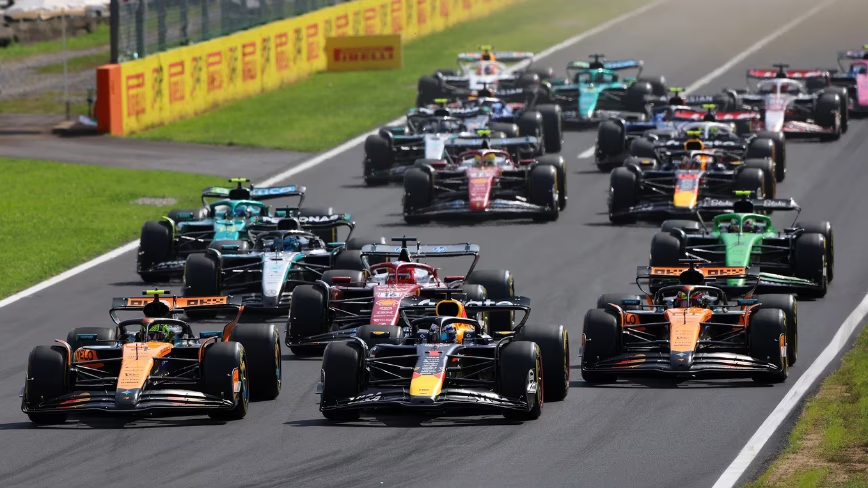
"We used to spend hours crunching telemetry data," said James Vowles, Williams team principal. "Claude does it in seconds, letting us focus on decision-making. This is a fundamental shift in how we approach race weekends."
McLaren's partnership with Google Cloud brings Gemini's machine learning to pit-stop optimization and tire degradation prediction. Red Bull's Oracle AI handles aerodynamic simulations and strategic calls. The 2026 rules also push teams toward open-source collaboration, but each partnership remains a closely guarded asset.

What This Means
The AI influx isn't just a tech upgrade—it's a commercial and competitive revolution. Smaller teams gain access to world-class AI without massive in-house investment. Meanwhile, tech giants like Google, Anthropic, and Oracle use F1 as a high-speed marketing platform to showcase real-time AI capabilities.
Fans can expect more AI-driven broadcasts, with algorithms predicting race strategies and highlighting overtakes. The sport's governing body, the FIA, is monitoring developments to ensure fairness. "AI is becoming as critical as the driver's reflexes," noted Mark Hughes, a veteran F1 analyst. "The 2026 regulations will separate teams that master AI from those that don't."
The eight partnerships signed in the past six months include deals with data analytics firms, cloud providers, and niche AI startups. Teams that delay integration risk falling behind in a sport where milliseconds matter. As the 2026 season approaches, the paddock is no longer just about horsepower—it's about processing power.
This story continues with updates from the FIA and team announcements.